The Missing Layer for Building World Models
As world models become the next operating system for intelligence, humanity will be its interface.
The transition from language models to world models represents the foundational shift of this new phase in AI from raining and basic chatbots to operational maturation, economic rationalization, and physical integration.
The excitement surrounding large language models has not diminished, but the center of gravity is beginning to shift. Increasingly, the conversation is moving beyond systems that generate language toward systems that construct internal representations of reality, models capable of simulating change, anticipating consequences, and reasoning about the world rather than merely describing it.
While language models predict the next word based on text patterns, world models build an internal, generalized simulation of physical reality, cause-and-effect, and human environments.
World models are hardly a new idea.
Cognitive scientists have studied human mental models for decades. Roboticists have long relied on internal representations of physical environments. Computer graphics, simulation, digital twins, systems dynamics, game engines, and even scientific visualization all depend on some form of computational world model. What feels new is not the concept itself, but the convergence of these disciplines with advances in artificial intelligence. World models are emerging as a common language across fields that were once largely independent.
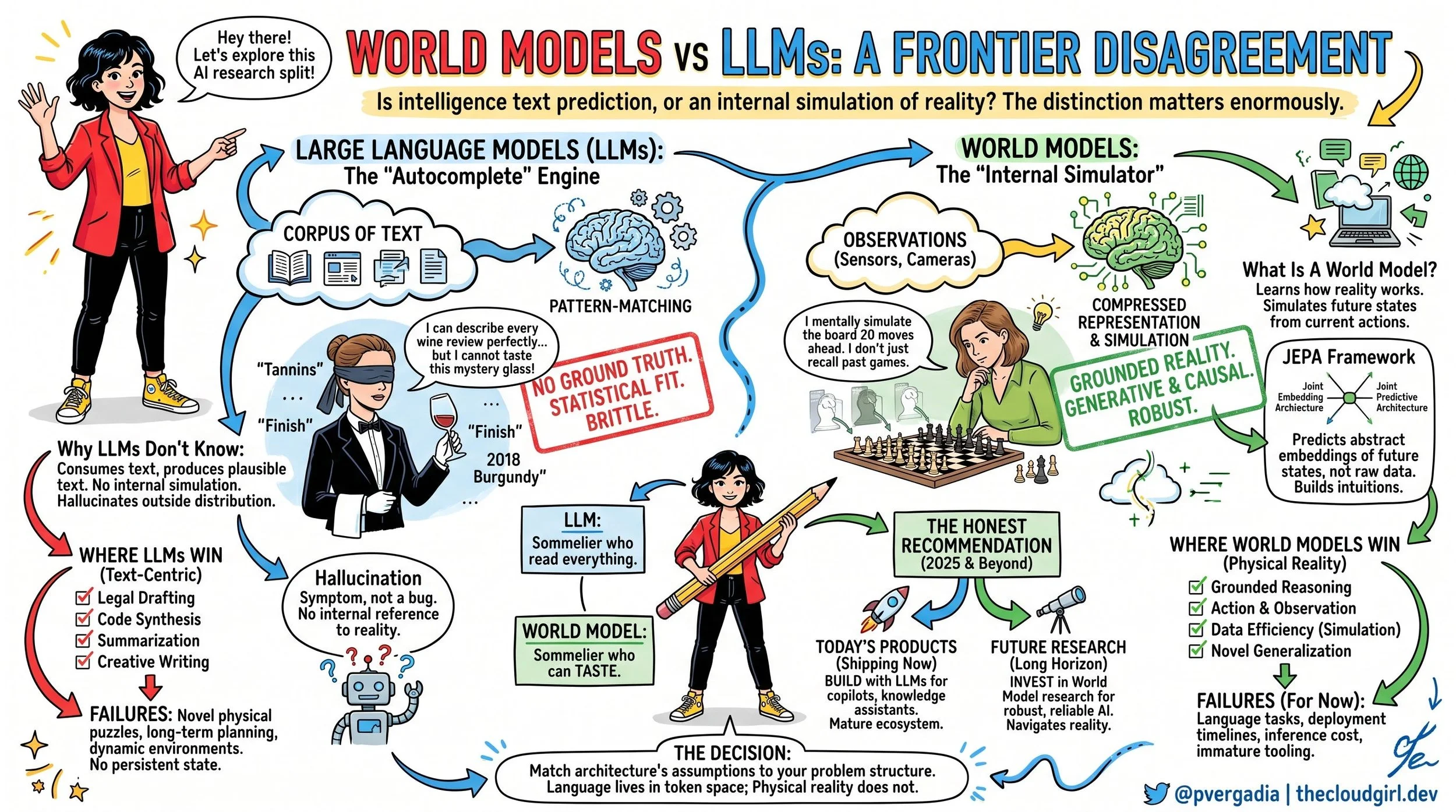
From Priyanka Vergadia’sWorld Models vs LLMs: Visually Explained(Substack)
We know how to build increasingly sophisticated world models. We do not yet know how people will build, understand, and inhabit them together.
That missing layer is a design problem.
This convergence has produced a remarkable body of engineering research. New architectures promise more robust planning. Enterprise researchers are exploring models that represent businesses instead of documents. Robotics researchers are developing systems that learn by predicting the consequences of their actions. Scientists are experimenting with models that can simulate complex physical systems before conducting costly experiments. Although these efforts differ in purpose and implementation, they share a common ambition: to build computational representations that capture enough of reality to support reasoning, prediction, and decision-making.
How will human beings interact with these models?
The question is deceptively simple. Every significant advance in computing has eventually required a corresponding advance in human interface design. Databases became useful through spreadsheets. The internet became accessible through browsers. Personal computing became mainstream through graphical interfaces. Search engines transformed vast collections of information into navigable experiences. In each case, the breakthrough was not simply a more capable computational system, but a more intelligible relationship between that system and the people using it.
World models appear to be approaching the same threshold.
Today, most interactions with AI take place through conversation. We ask questions, refine prompts, and receive increasingly sophisticated responses. That interaction model is well suited to language because language is the primary medium through which large language models operate. World models, however, are fundamentally different. Their purpose is not simply to answer questions. Their purpose is to represent systems, relationships, constraints, feedback, and change over time. A conversation may be an appropriate point of entry, but it cannot be the interface itself.
This is where I believe an entirely new discipline begins to emerge. Not another branch of artificial intelligence. A new layer of design. The human world model.